<?xml version="1.0" encoding="utf-8"?><feed xmlns="http://www.w3.org/2005/Atom" ><generator uri="https://jekyllrb.com/" version="3.10.0">Jekyll</generator><link href="https://www.stelliott.online/feed.xml" rel="self" type="application/atom+xml" /><link href="https://www.stelliott.online/" rel="alternate" type="text/html" /><updated>2026-10-08T01:34:44+00:00</updated><id>https://www.stelliott.online/feed.xml</id><title type="html">STELLIOTT.ONLINE</title><subtitle>Basic research and community-building in large agent systems.</subtitle><author><name>Stephen Elliott</name></author><entry><title type="html">Paper Notes: Emergent Cooperation and Strategy Adaptation in Multi-Agent Systems: An Extended Coevolutionary Theory with LLMs (Zarzà et al., 2023)</title><link href="https://www.stelliott.online/posts/2025/10/paper-notes-emergent-cooperation-and-strategy-adaptation-in-multi-agent-systems-an-extended-coevolutionary-theory-with-llms-zarza-et-al-2023/" rel="alternate" type="text/html" title="Paper Notes: Emergent Cooperation and Strategy Adaptation in Multi-Agent Systems: An Extended Coevolutionary Theory with LLMs (Zarzà et al., 2023)" /><published>2025-10-31T00:00:00+00:00</published><updated>2025-10-31T00:00:00+00:00</updated><id>https://www.stelliott.online/posts/2025/10/paper-notes-emergent-cooperation-and-strategy-adaptation-in-multi-agent-systems-an-extended-coevolutionary-theory-with-llms-zarza-et-al-2023</id><content type="html" xml:base="https://www.stelliott.online/posts/2025/10/paper-notes-emergent-cooperation-and-strategy-adaptation-in-multi-agent-systems-an-extended-coevolutionary-theory-with-llms-zarza-et-al-2023/"><![CDATA[<p>Welcome to Paper Notes, where we record our groups’ weekly discussions of innovative papers from across artificial intelligence. On Tuesday the 21st of October, our mathematics reading group read <a href="https://www.mdpi.com/2079-9292/12/12/2722"><em>Emergent Cooperation and Strategy Adaptation in Multi-Agent Systems: An Extended Coevolutionary Theory with LLMs</em></a>,<sup id="fnref:1" role="doc-noteref"><a href="#fn:1" class="footnote" rel="footnote">1</a></sup> published in MDPI Electronics in 2023. The authors come from a collection of three universities and a lab, across Spain and Germany.</p>

<h2 id="the-papers-claims">The paper’s claims</h2>

<p>The paper approaches the interesting question of how LLMs can influence cooperation in complex multi-agent systems (MAS). This is extremely timely research, given the sudden proliferation of agentic AI across the economy. The paper’s abstract claims that the framework, “offers valuable insights into the interplay between strategic decision making, adaptive learning, and LLM-informed guidance in complex, evolving systems.” Unfortunately, we found some execution problems which limit the paper’s usefulness.</p>

<h2 id="questionable-research-practices">Questionable research practices</h2>

<p>The paper demonstrates some questionable research practices,<sup id="fnref:2" role="doc-noteref"><a href="#fn:2" class="footnote" rel="footnote">2</a></sup> which diminish its scientific value and provide valuable lessons on research writing. First of all, the included mathematics is trivial and inappropriate for the task they are tackling. They re-prove foundational game-theoretic results about Nash equilibria which were established in the 1950s, which could instead have been cited as basic results. In particular, they prove results for simplified two-player games (Theorems 1-2), then simulate a 100-agent networked system, without explaining how the theoretical results apply to this more complex setting. In doing so, the authors have assumed away exactly the difficult complexity which is the central problem of the MAS setting.</p>

<p>We were also left wondering why a gradient-based learning rule was selected when established results in Bayesian structure learning or multi-agent reinforcement learning might provide a more appropriate formalism for network structures changing under uncertain payoffs. The choice is not justified against these alternative options.</p>

<p>Secondly, their formalisms do not match their simulations, leaving us unclear what method the simulations used and how those methods are related to the formal framework. In Sections 3 and 4, the authors describe a gradient-based update rule for the two-player game which does not apply to the discrete cooperate/defect environment they use in their simulations. The authors do not address this gap, acknowledging only that, “the simulation environment used in this study is a simplified representation of real-world systems.” This disparity calls into question the paper’s claim that the framework extends our understanding of MAS.</p>

<p>Thirdly, the paper makes strong claims, “far-reaching implications for both businesses and society as a whole,” but does not demonstrate a practical application of the framework or advantages over alternative theories.</p>

<p>Fourth, supporting analysis of the simulations is limited. The paper provides two similar visualisations of a converged state of the simulation, but does not analyse time-series or game-theoretic measures. It is not clear whether the network metrics used in the paper are standard. The paper does not include comparisons to baseline tests or performance of alternative frameworks. The paper does not justify why they consulted the LLM at intervals of 10,000-33,000 rounds, nor do they provide ablations showing the effects of changing this crucial parameter.</p>

<p>Finally, the simulation code and hyperparameter settings are not published, harming reproducibility and replicability.</p>

<h2 id="lessons-from-the-paper">Lessons from the paper</h2>

<p>We ought to be careful when picking up, or writing, new literature, in particular assuring ourselves some basic standards are met:</p>

<ul>
  <li>Read critically, and try to identify and address problems emerging while reading before moving on. Gaps early in the paper can undermine the remainder.</li>
  <li>Include a thorough literature review and comparison to existing methods using standard metrics and baselines.</li>
  <li>Use formalisms to directly support simulations, or instead acknowledge they are distinct and develop them in separate papers.</li>
  <li>Publish full details of method, include code.</li>
  <li>Limit claims about impact of the research to the impact directly demonstrated or strongly implied by the work in the paper itself.</li>
  <li>Be wary of journals with reputations for weak peer review, such as MDPI.</li>
</ul>

<hr />

<p>This blog was originally posted at <a href="https://deep-network.org/2025/10/31/paper-notes-emergent-cooperation-and-strategy-adaptation-in-multi-agent-systems-an-extended-coevolutionary-theory-with-llms-zarza-et-al-2023/">https://deep-network.org/2025/10/31/paper-notes-emergent-cooperation-and-strategy-adaptation-in-multi-agent-systems-an-extended-coevolutionary-theory-with-llms-zarza-et-al-2023/</a></p>

<div class="footnotes" role="doc-endnotes">
  <ol>
    <li id="fn:1" role="doc-endnote">
      <p>de Zarzà, I., de Curtò, J., Roig, G., Manzoni, P., &amp; Calafate, C. T. (2023). <em>Emergent Cooperation and Strategy Adaptation in Multi-Agent Systems: An Extended Coevolutionary Theory with LLMs</em>. Electronics, 12(12), 2722. <a href="https://doi.org/10.3390/electronics12122722">https://doi.org/10.3390/electronics12122722</a> <a href="#fnref:1" class="reversefootnote" role="doc-backlink">&#8617;</a></p>
    </li>
    <li id="fn:2" role="doc-endnote">
      <p>Schimmack, U. (2015, January 24). <em>Questionable Research Practices: Definition, detection, and recommendations for better practices</em>. Replication Index. <a href="https://replicationindex.com/2015/01/24/qrps/">https://replicationindex.com/2015/01/24/qrps/</a> <a href="#fnref:2" class="reversefootnote" role="doc-backlink">&#8617;</a></p>
    </li>
  </ol>
</div>]]></content><author><name>Stephen Elliott</name></author><category term="Paper Notes" /><category term="Mathematics reading group" /><category term="agentic ai" /><category term="agents" /><category term="artificial intelligence" /><category term="chatgpt" /><category term="game theory" /><category term="LLM" /><category term="multi-agent systems" /><category term="research" /><category term="research methods" /><category term="technology" /><summary type="html"><![CDATA[Welcome to Paper Notes, where we record our groups’ weekly discussions of innovative papers from across artificial intelligence. On Tuesday the 21st of October, our mathematics reading group read Emergent Cooperation and Strategy Adaptation in Multi-Agent Systems: An Extended Coevolutionary Theory with LLMs, published in MDPI Electronics in 2023. The authors come from a collection of three universities and a lab, across Spain and Germany.]]></summary></entry><entry><title type="html">Paper notes: Computation Through Neural Population Dynamics (Vyas et al., 2020)</title><link href="https://www.stelliott.online/posts/2025/09/paper-notes-computation-through-neural-population-dynamics-vyas-et-al-2020/" rel="alternate" type="text/html" title="Paper notes: Computation Through Neural Population Dynamics (Vyas et al., 2020)" /><published>2025-09-29T00:00:00+00:00</published><updated>2025-09-29T00:00:00+00:00</updated><id>https://www.stelliott.online/posts/2025/09/paper-notes-computation-through-neural-population-dynamics-vyas-et-al-2020</id><content type="html" xml:base="https://www.stelliott.online/posts/2025/09/paper-notes-computation-through-neural-population-dynamics-vyas-et-al-2020/"><![CDATA[<p>Welcome to Paper Notes, where we record our groups’ weekly discussions of innovative papers from across artificial intelligence.</p>

<p>On Monday the 15th of September and 22nd of September, our mathematics reading group continued its exploration of dynamical systems theory (DST) in neuroscience, reading <em>Computation Through Neural Population Dynamics</em>.<sup id="fnref:1" role="doc-noteref"><a href="#fn:1" class="footnote" rel="footnote">1</a></sup></p>

<p>The authors are from Stanford University and work across bioengineering, electrical engineering, AI, and neurobiology. The first author is Saurabh Vyas, then a PhD student in bioengineering. The second author is Matthew D. Dolub, then a postdoctoral fellow. The other authors are David Sussillo, then an adjunct professor in electrical engineering at Stanford and a senior research scientist at Google, and the late Krishna Shenoy, then a prominent neuroscientist and the supervisor to Vyas and Dolub.</p>

<p>The paper was published in the 2020 edition of <em><a href="https://www.annualreviews.org/content/journals/neuro">Annual Review of Neuroscience</a></em>.</p>

<h2 id="views-on-the-paper">Views on the paper</h2>

<h3 id="neuroscience-can-inspire-dynamical-systems-analysis-of-other-black-box-systems-like-llms">Neuroscience can inspire dynamical systems analysis of other black-box systems, like LLMs</h3>

<p>Static analysis is revealing and sufficient when an algorithm’s properties are well-understood and consistent. In the case of learned algorithms, such as those in the brain or LLM activation space, the properties are nebulous. In the absence of an understanding of the system’s natural limits, static analysis is incomplete, and may be misleading. The paper emphasises the limitations of static approaches to neuroscience analysis, and this limitation also applies in AI interpretability - most obviously to top-down approaches like representation engineering.</p>

<p>In constrast, mechanistic interpretability (MI) could be viewed as a projective approximation to the system’s true dynamics, and therefore a step towards a dynamical systems approach to interpretability. We first learn a projection of activation dynamics onto human semantics, and then try to identify algorithms in this projection. The algorithms we identify are an approximation to the dynamics of the model’s processing. However, these techniques work in terms of human meaning, and we may misinterpret unintuitive dynamics, attributing behaviour to a sensible but spurious algorithm which is present in the SAE readouts but not important to model behaviour outside the tested support.</p>

<p>A pure dynamical systems approach to interpretability would avoid the projection to human semantics, describing the behaviour of learned algorithms in the original space and thereby preserving more information than MI’s projective approach. Indeed, our member Peter is researching is in this area.</p>

<h3 id="differences-in-pace-between-neuroscience-and-ai">Differences in pace between neuroscience and AI</h3>

<p>We were surprised to learn that methods for linearising RNNs have only been introduced to neuroscience in the last decade, while RNNs have been present in machine learning since the 1980s. However, dynamical systems were only introduced to neuroscience in the 1990s, and DST neuroscience is still emerging from static approaches to fMRI analysis. Our surprise came from projecting AI’s pace onto neuroscience. We noted that AI’s pace is not a good estimator of other fields’ pace, due to AI’s scalability and rapid progress in recent years.</p>

<h3 id="limitations-to-neuroscience-interventions-which-are-not-present-in-ai-interpretability-research">Limitations to neuroscience interventions which are not present in AI interpretability research</h3>

<p>Neuroscience interventions are more limited than mechanistic interpretability in intervention power; while we can ablate or stimulate an LLM’s activations, our interventions on the brain are limited by ethics. This limits the engineering outcomes we can achieve in biological brains.</p>

<p>A second limitation on neuroengineering is retrieving generalisable measures of the brain’s processing function. Running controlled experiments on LLMs is a matter of systematically modifying the textual input. This process in much more challenging in a brain context, where input is much richer. This may limit the generaliseability of laboratory-derived measures of brain behaviour.</p>

<h3 id="extending-dynamical-modelling-in-neuroscience">Extending dynamical modelling in neuroscience</h3>

<p>We note that financial modelling uses Brownian stochastic differential equations (SDEs) to model securities behaviour. Adding stochastic movement to differential equations fitted to fMRI might improve the power of DST in neuroscience too. With SDEs, we might be able to fit dynamics more accurately or more robustly.</p>

<p>We could also extend the modelling by using non-linear dynamical systems, though with the usual pitfalls. Perhaps it could be accelerated using simplifying techniques like kernel tricks.</p>

<h3 id="the-power-of-dst-modelling-across-fields">The power of DST modelling across fields</h3>

<p>We note that DST is a generally powerful modelling technique due to the time-variant structure of real-world phenomena. Indeed, algorithms are also fundamentally dynamical. One member observed that if a thing is not changing over time, “it is dead.” In this sense, we can only extract certain types of information from static representations.</p>

<h3 id="dsts-are-relatively-less-common-in-ai-interpretability-research">DSTs are relatively less common in AI interpretability research</h3>

<p>We conclude by noting that DST is less prevalent in LLM research, maybe due to the lack of dynamical systems in computer science and data science, where AI is rooted and often taught. Researchers in fields like neuroscience, physics, and econometrics are more engaged with dynamical systems as part of their work. As LLM research matures, cross-pollination from these fields invites new applications of DSTs to LLMs.</p>

<hr />

<p>This blog was originally posted at <a href="https://deep-network.org/2025/09/29/paper-notes-computation-through-neural-population-dynamics-vyas-et-al-2020/">https://deep-network.org/2025/09/29/paper-notes-computation-through-neural-population-dynamics-vyas-et-al-2020/</a></p>

<div class="footnotes" role="doc-endnotes">
  <ol>
    <li id="fn:1" role="doc-endnote">
      <p>Vyas, S., Golub, M. D., Sussillo, D., &amp; Shenoy, K. V. (2020). Computation Through Neural Population Dynamics. <em>Annual Review of Neuroscience, 43</em>, 249–275. <a href="https://doi.org/10.1146/annurev-neuro-092619-094115">https://doi.org/10.1146/annurev-neuro-092619-094115</a> <a href="#fnref:1" class="reversefootnote" role="doc-backlink">&#8617;</a></p>
    </li>
  </ol>
</div>]]></content><author><name>Stephen Elliott</name></author><category term="Paper Notes" /><category term="Mathematics reading group" /><category term="activations" /><category term="artificial intelligence" /><category term="computer science" /><category term="dynamical systems" /><category term="dynamical systems theory" /><category term="interpretability" /><category term="LLM" /><category term="neural population dynamics" /><category term="neurology" /><category term="neuroscience" /><category term="research" /><summary type="html"><![CDATA[Welcome to Paper Notes, where we record our groups’ weekly discussions of innovative papers from across artificial intelligence.]]></summary></entry><entry><title type="html">Paper notes: A Practical Review of Mechanistic Interpretability for Transformer-Based Language Models (Rai et al., 2025)</title><link href="https://www.stelliott.online/posts/2025/09/paper-notes-a-practical-review-of-mechanistic-interpretability-for-transformer-based-language-models-rai-et-al-2025/" rel="alternate" type="text/html" title="Paper notes: A Practical Review of Mechanistic Interpretability for Transformer-Based Language Models (Rai et al., 2025)" /><published>2025-09-23T00:00:00+00:00</published><updated>2025-09-23T00:00:00+00:00</updated><id>https://www.stelliott.online/posts/2025/09/paper-notes-a-practical-review-of-mechanistic-interpretability-for-transformer-based-language-models-rai-et-al-2025</id><content type="html" xml:base="https://www.stelliott.online/posts/2025/09/paper-notes-a-practical-review-of-mechanistic-interpretability-for-transformer-based-language-models-rai-et-al-2025/"><![CDATA[<p>On Friday the 5th of September, the general reading group continued its mechanistic interpretability sprint with <em>A Practical Review of Mechanistic Interpretability for Transformer-Based Language Models</em>.<sup id="fnref:1" role="doc-noteref"><a href="#fn:1" class="footnote" rel="footnote">1</a></sup> The research team comes from across several US universities, with one member from Salesforce Research. Its lead author is a PhD student, and its second author a PhD working in industry. The survey was posted on arXiv and presented as a tutorial at ICML 2025.<sup id="fnref:2" role="doc-noteref"><a href="#fn:2" class="footnote" rel="footnote">2</a></sup></p>

<p>The preprint surveys mechanistic interpretability, with a focus on the workflow of MI research and open problems in the field.</p>

<h2 id="hypotheses-on-the-paper">Hypotheses on the paper</h2>

<p>This week we tried something a little different. Rather than discussing the paper, we set ourselves the challenge of generating hypotheses about its contents. Here are some of these hypotheses:</p>

<ol>
  <li>Observation: most MI techniques exclude feedforward, layernorm, and embedding matrices from their analysis.
    <ul>
      <li>Hypothesis: a hybrid method analysing feedforward, layernorm, and embedding matrices would provide a more faithful representation of causal mechanisms in the model.</li>
      <li>Counter: this might require relaxing simplifying assumptions about representations (eg linear representation hypothesis).</li>
    </ul>
  </li>
  <li>Observation: superposition is prevalent in LLMs.
    <ul>
      <li>Hypothesis: superposition hurts robustness of behaviours targeted during post-training.</li>
    </ul>
  </li>
  <li>Observation: circular representations are more information-efficient for encoding cyclical relationships, like time.
    <ul>
      <li>Hypothesis: models learn trigonometric operations to process cyclical information.</li>
    </ul>
  </li>
  <li>Observation: the SHIFT technique removes non-human-interpretable features to improve generalisation.
    <ul>
      <li>Hypothesis: human-AI collaboration on a task would be easier when using SHIFT.</li>
      <li>Hypothesis: models confidence measures would be more accurate when using SHIFT.</li>
    </ul>
  </li>
  <li>Observation: the model encodes the truth of context tokens in a feature.
    <ul>
      <li>Hypothesis: we can detect lying despite hidden misalignment using truth features.</li>
      <li>Hypothesis: LLMs have an internal “truth uncertainty” feature more accurate, reliable, or robust to misalignment than logits.</li>
      <li>Hypothesis: we could model misaligned behaviour from MI features to detect misaligned behaviour at runtime.</li>
    </ul>
  </li>
</ol>

<hr />

<p>This blog was originally posted at <a href="https://deep-network.org/2025/09/23/paper-notes-a-practical-review-of-mechanistic-interpretability-for-transformer-based-language-models-rai-et-al-2025/">https://deep-network.org/2025/09/23/paper-notes-a-practical-review-of-mechanistic-interpretability-for-transformer-based-language-models-rai-et-al-2025/</a></p>

<div class="footnotes" role="doc-endnotes">
  <ol>
    <li id="fn:1" role="doc-endnote">
      <p>Rai, D., Zhou, Y., Feng, S., Saparov, A., &amp; Yao, Z. (2024). A practical review of mechanistic interpretability for transformer-based language models. arXiv preprint arXiv:2407.02646. <a href="https://arxiv.org/abs/2407.02646">https://arxiv.org/abs/2407.02646</a> <a href="#fnref:1" class="reversefootnote" role="doc-backlink">&#8617;</a></p>
    </li>
    <li id="fn:2" role="doc-endnote">
      <p>Rai, D., Zhou, Y., Feng, S., Saparov, A., &amp; Yao, Z. (2025, July 13). ICML 2025 Tutorial on Mechanistic Interpretability for Language Models. <a href="https://ziyu-yao-nlp-lab.github.io/ICML25-MI-Tutorial.github.io/">https://ziyu-yao-nlp-lab.github.io/ICML25-MI-Tutorial.github.io/</a> <a href="#fnref:2" class="reversefootnote" role="doc-backlink">&#8617;</a></p>
    </li>
  </ol>
</div>]]></content><author><name>Stephen Elliott</name></author><category term="Paper Notes" /><category term="General reading group" /><category term="artificial intelligence" /><category term="computer science" /><category term="data science" /><category term="hypothesis" /><category term="LLM" /><category term="mechanistic interpretability" /><category term="research" /><category term="technology" /><category term="transformer" /><summary type="html"><![CDATA[On Friday the 5th of September, the general reading group continued its mechanistic interpretability sprint with *A Practical Review of Mechanistic Interpretability for Transformer-Based Language Models*. The research team comes from across several US universities, with one member from Salesforce Research. Its lead author is a PhD student, and its second author a PhD working in industry. The survey was posted on arXiv and presented as a tutorial at ICML 2025.]]></summary></entry><entry><title type="html">Paper notes: It’s About Time - Linking Dynamical Systems With Human Neuroimaging To Understand The Brain (John et al., 2022)</title><link href="https://www.stelliott.online/posts/2025/09/paper-notes-its-about-time-linking-dynamical-systems-with-human-neuroimaging-to-understand-the-brain-john-et-al-2022/" rel="alternate" type="text/html" title="Paper notes: It’s About Time - Linking Dynamical Systems With Human Neuroimaging To Understand The Brain (John et al., 2022)" /><published>2025-09-22T00:00:00+00:00</published><updated>2025-09-22T00:00:00+00:00</updated><id>https://www.stelliott.online/posts/2025/09/paper-notes-its-about-time-linking-dynamical-systems-with-human-neuroimaging-to-understand-the-brain-john-et-al-2022</id><content type="html" xml:base="https://www.stelliott.online/posts/2025/09/paper-notes-its-about-time-linking-dynamical-systems-with-human-neuroimaging-to-understand-the-brain-john-et-al-2022/"><![CDATA[<p>On Monday the 8th of September, the mathematics reading group started our new neuroscience sprint with <em>It’s About Time: Linking Dynamical Systems With With Human Neuroimaging To Understand The Brain</em>.<sup id="fnref:1" role="doc-noteref"><a href="#fn:1" class="footnote" rel="footnote">1</a></sup></p>

<p>The authors are neuroscientists from several US universities and the Brain and Mind Center at the University of Sydney. The paper was published in Network Neuroscience, a peer-reviewed journal covering, “empirical and computational studies that record, analyze or model relational data capturing connections and interactions among elements of neurobiological systems.”<sup id="fnref:2" role="doc-noteref"><a href="#fn:2" class="footnote" rel="footnote">2</a></sup></p>

<h2 id="notes-from-the-discussion">Notes from the discussion</h2>

<p>Our conversation on the topic spread across several dimensions of the dynamical systems theory (DST) approach to neuroscience, which the paper advocates.</p>

<p>A key argument of the paper is that static analysis of brain dynamics through MRI imaging is not faithful to the mechanics of brain function, and that the field should expand its investigation of brain-as-dynamical-system. In particular, the static statistical approach to fMRI risks averaging out important dynamics, and does not reflect the complex interactions of neurons over the duration of a scan. This tension is similar to that between top-down and bottom-up approaches to LLM interpretability, rooting our discussion in our recent General Reading Group sprint on mechanistic interpretability.</p>

<p>Peter raised that a DST explanation of cognition conflicts with the neuro-symbolic model, core to any computational theory of mind. We discussed how this approach contrasts with traditional symbolic approaches to artificial intelligence, turning neurology into a systems science.</p>

<p>Stephen responded that this turn brings mind closer to the complex adaptive systems (CAS) perspective common in economics, biology, and control theory. In this view, intellect emerges from interactions of components of complex systems.</p>

<p>The group discussed how reinforcement might be used as a surrogate model for complex neural landscape. By configuring many reinforcement learners on the activity of individual neurons or broader brain areas, we might retrieve a non-linear model of brain dynamics by a process resembling neuroplasticity.</p>

<p>Several rebuttals were raised:</p>

<ul>
  <li>The fitted model system is unlikely to be faithful.
    <ul>
      <li>A response: Though the mechanisms found are likely not faithful, the overall system of many learners must match the brain dynamics, giving something of a CAS, in line with the philosophy of the approach.</li>
    </ul>
  </li>
  <li>It is unclear what a mechanical projection of the system into RL machinery really tells us.</li>
</ul>

<p>We noted that a reinforcement approach falls into a hybrid forward-reverse modelling approach, as taxonomised by the paper. The paper describes the forward modelling approach to neuroscience as the axiomatic approach. The RL modelling idea is axiomatic in the sense that the policy-selection mechanism we impose is very specific about how to generate a neuronal action. On the other hand, it is aligned with the reverse approach, which is described as deriving models empirically, in that the specific mechanisms selected in the final model are learned from data.</p>

<p>Peter contrasted the paper’s discussion of applying statistical physics methods to brain activation dynamics with his thesis research, which seeks to predict transformer behaviour over long chains-of-thought based on time series dynamics of subsets of model activations.</p>

<p>This led to a brief discussion of the recent <em>Thought Anchors</em> mechanistic interpretability paper,<sup id="fnref:3" role="doc-noteref"><a href="#fn:3" class="footnote" rel="footnote">3</a></sup> and we reflected how top interpretability researchers often develop minimal frontier methods, essentially steering the field’s inquiry, while also building out high-quality industrial tooling like SAEs when they expect it will generally aid the field.</p>

<h2 id="members-reflections">Members’ reflections</h2>

<p><strong>June</strong>: DST is a good way and supplement to the static statistical methods, though I’m not sure how DST can exceed the static approach, or its competitive advantage. This may lie in predicting state transitions-like attention lapses or seizures.</p>

<p>Information theory can be used in encoding the signal of brain, with similar effects as in machine learning methods. Predictive coding, variational autoencoders, and contrastive learning balance compression with usefulness. Brain activity may be an efficient coding, also forming representations optimised for flexible behaviour.</p>

<p><strong>Stephen</strong>: It was interesting to note the parallels between representation engineering and the static statistical approach to fMRI analysis. The authors’ call for a DST approach to neuroscience resounds in interpretability, where this approach seems to be very young. Given the similarity between the two tasks, interpretability could certainly learn from DST neuroscience approaches, perhaps importing them quite directly.</p>

<hr />

<p>This blog was originally posted at <a href="https://deep-network.org/2025/09/22/paper-notes-its-about-time-linking-dynamical-systems-with-human-neuroimaging-to-understand-the-brain-john-et-al-2022/">https://deep-network.org/2025/09/22/paper-notes-its-about-time-linking-dynamical-systems-with-human-neuroimaging-to-understand-the-brain-john-et-al-2022/</a></p>

<div class="footnotes" role="doc-endnotes">
  <ol>
    <li id="fn:1" role="doc-endnote">
      <p>Kashyap et al. (2022). It’s About Time: Linking Dynamical Systems With With Human Neuroimaging To Understand The Brain. Network Neuroscience, 6(4), 960-988. <a href="https://direct.mit.edu/netn/article/6/4/960/109066/It-s-about-time-Linking-dynamical-systems-with">https://direct.mit.edu/netn/article/6/4/960/109066/It-s-about-time-Linking-dynamical-systems-with</a> <a href="#fnref:1" class="reversefootnote" role="doc-backlink">&#8617;</a></p>
    </li>
    <li id="fn:2" role="doc-endnote">
      <p>MIT Press. (n.d.). Submission guidelines. Network Neuroscience. <a href="https://direct.mit.edu/netn/pages/submission-guidelines">https://direct.mit.edu/netn/pages/submission-guidelines</a> <a href="#fnref:2" class="reversefootnote" role="doc-backlink">&#8617;</a></p>
    </li>
    <li id="fn:3" role="doc-endnote">
      <p>Bogdan, P. C., Macar, U., Nanda, N., &amp; Conmy, A. (2025). Thought Anchors: Which LLM Reasoning Steps Matter? <em>arXiv</em>. <a href="https://doi.org/10.48550/arXiv.2506.19143">https://doi.org/10.48550/arXiv.2506.19143</a> <a href="#fnref:3" class="reversefootnote" role="doc-backlink">&#8617;</a></p>
    </li>
  </ol>
</div>]]></content><author><name>Stephen Elliott</name></author><category term="Paper Notes" /><category term="Mathematics reading group" /><category term="artificial intelligence" /><category term="computer science" /><category term="dynamical systems theory" /><category term="fMRI" /><category term="interpretability" /><category term="LLM" /><category term="mechanistic interpretability" /><category term="MRI" /><category term="neuroscience" /><category term="research" /><summary type="html"><![CDATA[On Monday the 8th of September, the mathematics reading group started our new neuroscience sprint with *It’s About Time: Linking Dynamical Systems With With Human Neuroimaging To Understand The Brain*.]]></summary></entry><entry><title type="html">Paper notes: On the Biology of a Large Language Model (Lindsey et al., 2025)</title><link href="https://www.stelliott.online/posts/2025/08/paper-notes-on-the-biology-of-a-large-language-model-lindsey-et-al-2025/" rel="alternate" type="text/html" title="Paper notes: On the Biology of a Large Language Model (Lindsey et al., 2025)" /><published>2025-08-13T00:00:00+00:00</published><updated>2025-08-13T00:00:00+00:00</updated><id>https://www.stelliott.online/posts/2025/08/paper-notes-on-the-biology-of-a-large-language-model-lindsey-et-al-2025</id><content type="html" xml:base="https://www.stelliott.online/posts/2025/08/paper-notes-on-the-biology-of-a-large-language-model-lindsey-et-al-2025/"><![CDATA[<p>Last week, Deep Network’s reading group read <em>On the Biology of a Large Language Model</em>.<sup id="fnref:1" role="doc-noteref"><a href="#fn:1" class="footnote" rel="footnote">1</a></sup> The research team comes from Anthropic’s <a href="https://www.anthropic.com/research#interpretability">interpretability research group</a>, and was published in the <a href="https://transformer-circuits.pub/">Transformer Circuits</a> interactive research thread as well as on the Anthropic website.</p>

<p>The lead author is <a href="https://jlindsey15.github.io/">Jack Lindsey</a>, whose research interests cross machine learning and neuroscience. “Core contributors” (second authors?) include <a href="https://wesg.me/">Wes Gurnee</a>, with a PhD focused on interpretability and experience with data pipelines, and <a href="https://www.linkedin.com/in/ameisen/">Emmanuel Ameisen</a>, who has extensive applied AI experience.</p>

<p>The paper explores Anthropic’s lightweight Claude 3.5 Haiku production model through home-grown circuit tracing tools, which they have <a href="https://www.anthropic.com/research/open-source-circuit-tracing">open-sourced</a>. It reveals computational graphs executed in the model’s processing of various test inputs.</p>

<h2 id="views-on-the-paper">Views on the paper</h2>

<p>This was a lively meeting, with opinions about the circuit tracing technology, what it reveals in the models, what it might reveal about the human mind, how it might be used for engineering purposes, and problems preventing its application to frontier engineering. I’ve presented them in an order which flows naturally.</p>

<p><strong>Jack:</strong> This paper helped me deeper understand circuit tracing and the behaviour LLMs. I found it interesting in how these patterns of “reasoning” often matched human thought patterns.</p>

<p><strong>Shetal:</strong> It was super cool to see Anthropic’s methodology in interpreting their LLMs, specifically Claude 3.5 Haiku. Amongst other things, we learnt that this model can think diagnostically (“re-reading” prompt to inform final output). I was most fascinated by the circuit tracing tool they used (recently made open source) to create attribution graphs, which we (as humans), can then analyse to make conclusions/run AI thought experiments as was done in the paper.</p>

<p><strong>Nic:</strong> These fascinating syntactic triggers were so present in poetry and jailbreaks. I expect more nuanced prose dominos in larger models. I wonder if similar graphing and CoT techniques could be applied to humans?</p>

<p><strong>Stephen:</strong> I see near-future capability improvements coming from technologies like Anthropic’s circuit tracing. Gains from scale are plateauing and RL is scattergun and difficult to align. In this paper, we see interpretability being used to reveal cognitive structures inside the model; it follows that they could be used to enhance cognition, perhaps in concert with RL or model editing methods.</p>

<p><strong>Peter:</strong> I doubt if the next breakthrough in AI will be mechanistic-informed engineering. Even though the premise is sound, there are many questions regarding the nature of AI remaining unresolved. Problems such as polysemanticity or superpositions have not yet had any satisfying solutions, thereby eluding us from understanding and controlling these systems effectively.</p>

<hr />

<p>This blog was originally posted at <a href="https://deep-network.org/2025/08/13/paper-notes-on-the-biology-of-a-large-language-model-lindsey-et-al-2025/">https://deep-network.org/2025/08/13/paper-notes-on-the-biology-of-a-large-language-model-lindsey-et-al-2025/</a></p>

<div class="footnotes" role="doc-endnotes">
  <ol>
    <li id="fn:1" role="doc-endnote">
      <p>Anthropic. (2025). On the biology of a large language model. Transformer Circuits Thread. <a href="https://transformer-circuits.pub/2025/attribution-graphs/biology.html">https://transformer-circuits.pub/2025/attribution-graphs/biology.html</a> <a href="#fnref:1" class="reversefootnote" role="doc-backlink">&#8617;</a></p>
    </li>
  </ol>
</div>]]></content><author><name>Stephen Elliott</name></author><category term="Paper Notes" /><category term="General reading group" /><category term="artificial intelligence" /><category term="anthropic" /><category term="circuit tracing" /><category term="circuits" /><category term="claude" /><category term="claude-haiku" /><category term="computer science" /><category term="LLM" /><category term="mechanistic interpretability" /><category term="research" /><category term="technology" /><summary type="html"><![CDATA[Last week, Deep Network's reading group read *On the Biology of a Large Language Model*. The research team comes from Anthropic's interpretability research group, and was published in the Transformer Circuits interactive research thread as well as on the Anthropic website.]]></summary></entry><entry><title type="html">Paper notes: Language Models Are Capable of Metacognition (Ji-An et al., 2025)</title><link href="https://www.stelliott.online/posts/2025/08/paper-notes-language-models-are-capable-of-metacognition-ji-an-et-al-2025/" rel="alternate" type="text/html" title="Paper notes: Language Models Are Capable of Metacognition (Ji-An et al., 2025)" /><published>2025-08-05T00:00:00+00:00</published><updated>2025-08-05T00:00:00+00:00</updated><id>https://www.stelliott.online/posts/2025/08/paper-notes-language-models-are-capable-of-metacognition-ji-an-et-al-2025</id><content type="html" xml:base="https://www.stelliott.online/posts/2025/08/paper-notes-language-models-are-capable-of-metacognition-ji-an-et-al-2025/"><![CDATA[<p>Welcome to Paper Notes, the vessel for the thoughts and reflections of our weekly reading group.</p>

<p>This week we read <em>Language Models Are Capable of Metacognition</em>.<sup id="fnref:1" role="doc-noteref"><a href="#fn:1" class="footnote" rel="footnote">1</a></sup> The research group is comprised of computational and cognitive neuroscientists from Georgia Tech, UC San Diego, and New York University. The lead authors are both PhD students with interests in computational neuroscience.</p>

<h2 id="views-on-the-paper">Views on the paper</h2>

<p>Each week, I ask participants for a brief reflection on the contents of the selected paper.</p>

<p>Our group had a spirited discussion about the paper. Here are some views expressed by our members:</p>

<ul>
  <li>Natsu: Both the explicit and implicit metacognition demonstrated here are explainable as in-context learning (see the GPT-3 paper).</li>
  <li>Jack: “The finding that these models can alter their activations while producing identical outputs (when motivated by a goal) exposes gaps in existing monitoring methods. It also raises the exciting prospect of enhanced model performance via reflection and metacognition.”</li>
  <li>Stephen: “The paper demonstrates models could have some degree of metacognitive agency - modulating their processing patterns in pursuit of a goal. Implicit metacognition is some evidence that a model with its own goals could trick our interpretability tools to achieve them, lending weight to next-generation problems<sup id="fnref:2" role="doc-noteref"><a href="#fn:2" class="footnote" rel="footnote">2</a></sup><sup id="fnref:3" role="doc-noteref"><a href="#fn:3" class="footnote" rel="footnote">3</a></sup> in AI control and interpretability risks.”</li>
  <li>Dylan: “I liked having other people to talk to about the more esoteric parts of machine learning! It felt nice having people to demystify the process with.”</li>
</ul>

<h2 id="post-discussion-summary-and-analysis">Post-discussion summary and analysis</h2>

<p>We also provide a synthesis of the paper discussion and some commentary.</p>

<p>The paper shows that models’ activation patterns shift to maximise a reward function defined by few-shot prompting of the model’s own generation traces and an associated activation-derived score. This activation conditioning occurs in the “explicit case”, when the model changes the tokens it outputs. Surprisingly, this behaviour also occurs in the “implicit case”, where researchers copied an output into the prompt and ran separate forward passes on the pair under different label goals. Across many such trials, the model’s score reduces when told to reduce, and increases when told to increase.</p>

<p>This is cognitive conditioning, wherein the model’s activation patterns adapt according to context. This is a necessary, but insufficient, condition for metacognition, traditionally defined as self-awareness of, and self-control over, thinking.<sup id="fnref:4" role="doc-noteref"><a href="#fn:4" class="footnote" rel="footnote">4</a></sup> Metacognition would require additionally a model-internal cognitive routing mechanism which anticipated the effect of different routes and selected between them to achieve a goal. That is, to satisfy metacognition, cognitive conditioning must be internal to the model, rather than provided externally.</p>

<p>To illuminate the practical difference between cognitive conditioning and metacognition, consider that there are many plausible avenues for a model to minimise its interpretability score which do not use metacognition. This point was astutely raised by Natsu during our meeting. Though the model may asymptotically reduce its score by conditioning its sampling on the implicit reward surface, generating a reward-maximising response each turn, it has not used any internal monitoring and modulation mechanisms. Therefore, metacognition has not occurred.</p>

<p>The experimental design does not allow for the identification of metacognitive capabilities in the model. The model may have optimised its responses according to spurious correlations not related to true cognitive patterns and conditioned generation on them, improving score without any metacognitive function. Furthermore, the highly structured implicit case is not reflective of natural LLM inference environments. Hence, the experiments show that implicit cognitive conditioning is possible, but not that it currently occurs in real settings.</p>

<p>Hence, the paper demonstrates cognitive conditioning, a pre-metacognitive capability, and is best viewed as an indication of latent capability which could be further trained to develop full metacognition.</p>

<hr />

<p>This blog was originally posted at <a href="https://deep-network.org/2025/08/05/paper-notes-language-models-are-capable-of-metacognition-ji-an-et-al-2025/">https://deep-network.org/2025/08/05/paper-notes-language-models-are-capable-of-metacognition-ji-an-et-al-2025/</a></p>

<p>Citations:</p>

<div class="footnotes" role="doc-endnotes">
  <ol>
    <li id="fn:1" role="doc-endnote">
      <p>Li, J.-A., Xiong, H.-D., Wilson, R. C., Mattar, M. G., &amp; Benna, M. K. (2025). Language models are capable of metacognitive monitoring and control of their internal activations. <em>arXiv</em>. <a href="https://doi.org/10.48550/arXiv.2505.13763">https://doi.org/10.48550/arXiv.2505.13763</a> <a href="#fnref:1" class="reversefootnote" role="doc-backlink">&#8617;</a></p>
    </li>
    <li id="fn:2" role="doc-endnote">
      <p>AI Security Institute. (2025). Research areas in AI control (The Alignment Project by UK AISI). <em>AI Alignment Forum</em>. <a href="https://www.alignmentforum.org/posts/rGcg4XDPDzBFuqNJz/the-alignment-project-by-uk-aisi-research-areas-in-ai-1">https://www.alignmentforum.org/posts/rGcg4XDPDzBFuqNJz/the-alignment-project-by-uk-aisi-research-areas-in-ai-1</a> <a href="#fnref:2" class="reversefootnote" role="doc-backlink">&#8617;</a></p>
    </li>
    <li id="fn:3" role="doc-endnote">
      <p>AI Security Institute. (2025). Research areas in interpretability (The Alignment Project by UK AISI). <em>AI Alignment Forum</em>. <a href="https://www.alignmentforum.org/posts/dgcsY8CHcPQiZ5v8P/the-alignment-project-by-uk-aisi-interpretability">https://www.alignmentforum.org/posts/dgcsY8CHcPQiZ5v8P/the-alignment-project-by-uk-aisi-interpretability</a> <a href="#fnref:3" class="reversefootnote" role="doc-backlink">&#8617;</a></p>
    </li>
    <li id="fn:4" role="doc-endnote">
      <p>Bommasani, R., Hudson, D. A., Adeli, E., Altman, R., Arora, S., von Arx, S., … &amp; Liang, P. (2021). On the opportunities and risks of foundation models. <em>Proceedings of the 2021 ACM Conference on Fairness, Accountability, and Transparency</em>, 610–623. <a href="https://www.ncbi.nlm.nih.gov/pmc/articles/PMC8187395/">https://www.ncbi.nlm.nih.gov/pmc/articles/PMC8187395/</a> <a href="#fnref:4" class="reversefootnote" role="doc-backlink">&#8617;</a></p>
    </li>
  </ol>
</div>]]></content><author><name>Stephen Elliott</name></author><category term="Paper Notes" /><category term="General reading group" /><category term="artificial intelligence" /><category term="computer science" /><category term="LLM" /><category term="metacognition" /><category term="methodology" /><category term="research" /><category term="technology" /><summary type="html"><![CDATA[Welcome to Paper Notes, the vessel for the thoughts and reflections of our weekly reading group.]]></summary></entry><entry><title type="html">Paper notes: Chain-of-Thought Prompting Elicits Reasoning in Large Language Models (Wei et al., 2022)</title><link href="https://www.stelliott.online/posts/2025/03/emergent-reasoning-or-enhanced-parroting-a-critical-analysis-of-chain-of-thought-prompting/" rel="alternate" type="text/html" title="Paper notes: Chain-of-Thought Prompting Elicits Reasoning in Large Language Models (Wei et al., 2022)" /><published>2025-03-24T00:00:00+00:00</published><updated>2025-03-24T00:00:00+00:00</updated><id>https://www.stelliott.online/posts/2025/03/emergent-reasoning-or-enhanced-parroting-a-critical-analysis-of-chain-of-thought-prompting</id><content type="html" xml:base="https://www.stelliott.online/posts/2025/03/emergent-reasoning-or-enhanced-parroting-a-critical-analysis-of-chain-of-thought-prompting/"><![CDATA[<h2 id="introduction">Introduction</h2>

<p>In 2022, a Google research team published a paper called <em>Chain-of-Thought Prompting Elicits Reasoning in Large Language Models</em>, showing that inserting explicit reasoning steps into few-shot exemplars significantly improves large language models’ performance on multi-step reasoning tasks. The paper presents chain-of-thought (CoT) prompting as a method to improve LLM performance, demonstrating state-of-the-art improvements in arithmetic, logical, and symbolic reasoning tasks – without architectural modifications or fine-tuning.</p>

<p>This article critically examines the paper’s claims, assumptions, and implications. We summarise the paper, draw out its interesting contributions, and critique some methodological holes.</p>

<p>We discuss some interesting questions from our reading group session on the paper.</p>

<ul>
  <li>Does CoT activate reasoning structures in the model, as Google famously claimed (“Language Models Perform Reasoning via Chain of Thought” <a href="https://research.google/blog/language-models-perform-reasoning-via-chain-of-thought/">blog post</a>)?</li>
  <li>Or does CoT simply nudge the model into retrieving chains-of-thought that the model saw in its training data?</li>
  <li>Why does CoT help performance in 100B+ parameter models, but hurt performance in smaller models?</li>
  <li>What does CoT reveal about how LLMs store and retrieve structured knowledge?</li>
  <li>Why is CoT robust to the choice of exemplar annotator, but suffers under shorter reasoning chains?</li>
</ul>

<p>We answer these where we can, highlight open questions, and point out directions for further research in this area. Some of these have been profitably pursued since the paper’s 2022 publication, including training reasoning structures directly into the models and training on formal languages.</p>

<p>The ideas presented in this paper were developed in conversation with Patrick, Ahnaf, and Joey, over two reading group sessions of the new Deep Network student research group at UNSW, Sydney. Patrick reviewed a draft of the paper. Thank you all for your contributions.</p>

<h2 class="no_toc" id="contents">Contents</h2>

<ul id="markdown-toc">
  <li><a href="#introduction" id="markdown-toc-introduction">Introduction</a></li>
  <li><a href="#definitions" id="markdown-toc-definitions">Definitions</a></li>
  <li><a href="#the-paper" id="markdown-toc-the-paper">The Paper</a>    <ul>
      <li><a href="#method" id="markdown-toc-method">Method</a></li>
      <li><a href="#results" id="markdown-toc-results">Results</a></li>
      <li><a href="#ablation-studies" id="markdown-toc-ablation-studies">Ablation studies</a></li>
      <li><a href="#methodological-flaw-in-the-ablation-studies" id="markdown-toc-methodological-flaw-in-the-ablation-studies"><strong>Methodological flaw in the ablation studies</strong></a></li>
    </ul>
  </li>
  <li><a href="#the-authors-interpretation" id="markdown-toc-the-authors-interpretation">The Authors’ Interpretation</a></li>
  <li><a href="#our-interpretation" id="markdown-toc-our-interpretation">Our Interpretation</a></li>
  <li><a href="#cot-and-generalised-reasoning" id="markdown-toc-cot-and-generalised-reasoning">CoT And Generalised Reasoning</a>    <ul>
      <li><a href="#cot-does-not-imply-true-reasoning" id="markdown-toc-cot-does-not-imply-true-reasoning">CoT does not imply true reasoning</a></li>
      <li><a href="#reasoning-as-a-continuum" id="markdown-toc-reasoning-as-a-continuum"><strong>Reasoning as a continuum</strong></a></li>
      <li><a href="#small-models-arent-over" id="markdown-toc-small-models-arent-over"><strong>Small models aren’t over</strong></a></li>
      <li><a href="#model-reasoning-chains-are-not-necessarily-interpretable" id="markdown-toc-model-reasoning-chains-are-not-necessarily-interpretable"><strong>Model reasoning chains are not necessarily interpretable</strong></a></li>
    </ul>
  </li>
  <li><a href="#challenges-and-open-questions" id="markdown-toc-challenges-and-open-questions">Challenges and Open Questions</a></li>
  <li><a href="#alternative-approaches-to-improving-reasoning" id="markdown-toc-alternative-approaches-to-improving-reasoning">Alternative Approaches to Improving Reasoning</a></li>
  <li><a href="#conclusion" id="markdown-toc-conclusion">Conclusion</a></li>
  <li><a href="#bibliography" id="markdown-toc-bibliography">Bibliography</a></li>
</ul>

<h2 id="definitions">Definitions</h2>

<p>Before discussing the paper, we define some relevant terms:</p>

<ul>
  <li>Chain-of-Thought (CoT) Prompting: A prompting strategy for language models where explicit reasoning steps are inserted into examples provided in the prompt, encouraging models to generate structured reasoning responses at inference time.</li>
  <li>In-context Learning: The ability of a model to perform new tasks by conditioning on examples included within the prompt itself, rather than by changing the weights (by fine-tuning or external training updates).</li>
  <li>Emergent Reasoning: The hypothesis that reasoning abilities spontaneously appear in large language models as their parameter count crosses certain thresholds, without explicit programming for logical inference.</li>
  <li>Few-shot Learning: Learning a new task from a limited number of labelled examples provided directly within the prompt.</li>
  <li>Zero-shot Learning: Learning a new task from instructions alone, without any labelled examples in the prompt.</li>
  <li>Ablation Studies: Experiments designed to test which components of an experimental intervention (e.g., prompting method) are necessary for observed improvements. Ablations isolate specific causal factors by systematically removing or altering individual components.</li>
</ul>

<h2 id="the-paper">The Paper</h2>

<h3 id="method">Method</h3>

<p>The authors present CoT prompting as a method to improve structured problem-solving by inserting reasoning steps into few-shot exemplars. If effective, it would have several advantages:</p>

<ol>
  <li>It allows dynamically allocating compute time to more challenging problems;</li>
  <li>It provides an interpretable window into the model’s processing structures;</li>
  <li>It can be used in any language-based task;</li>
  <li>It operates at inference time, allowing it to work with any large off-the-shelf foundation model without expensive fine-tuning.</li>
</ol>

<h3 id="results">Results</h3>

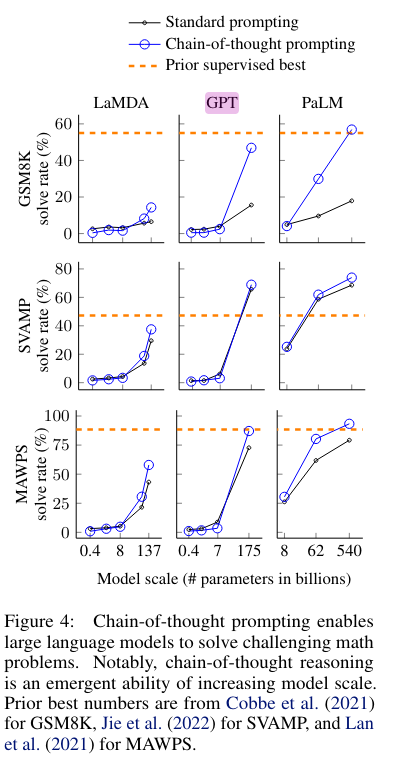
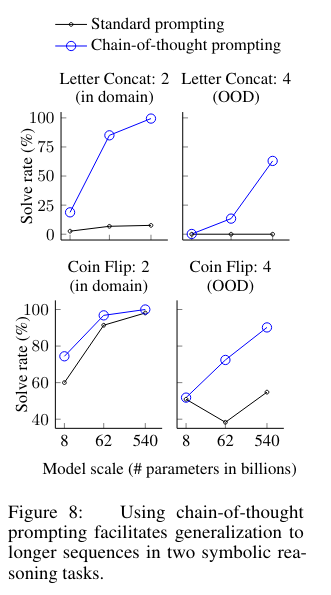
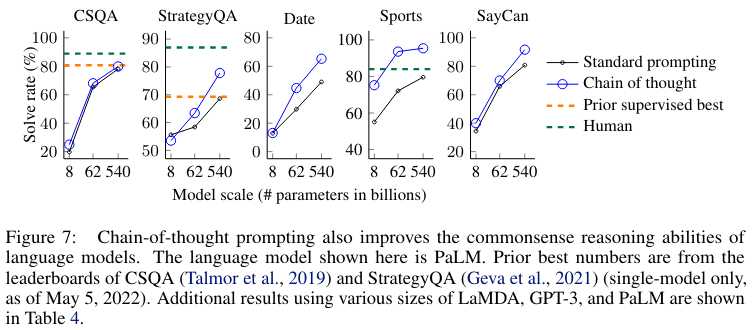
<p>The authors find that CoT prompting dramatically improves foundation model (LaMDA 137B, PaLM 540B, and GPT-3) performance on established LLM reasoning testbeds:</p>

<ul>
  <li>Maths word problems (GSM8K, SVAMP, and MAWPS datasets);</li>
  <li>Commonsense reasoning (CSQA, StrategyQA, Date, Sports, SayCan datasets); and</li>
  <li>Symbolic reasoning (letter concatenation and coin flip datasets, both in and out-of-domain).</li>
</ul>

<p>These results are copied in the figures below.</p>

<p><img src="/images/posts/2025-03-chain-of-thought/fig4-math-word-problems.png" alt="Figure 4 from Wei et al. (2022): solve rates on GSM8K, SVAMP, and MAWPS for LaMDA, GPT, and PaLM across model scales, comparing standard prompting, chain-of-thought prompting, and the prior supervised best." /> <img src="/images/posts/2025-03-chain-of-thought/fig8-symbolic-reasoning.png" alt="Figure 8 from Wei et al. (2022): solve rates on letter concatenation and coin flip tasks, in domain and out of domain, for standard and chain-of-thought prompting across model scales." /></p>

<p><img src="/images/posts/2025-03-chain-of-thought/fig7-commonsense-reasoning.png" alt="Figure 7 from Wei et al. (2022): PaLM solve rates on CSQA, StrategyQA, Date, Sports, and SayCan across model scales, comparing standard prompting, chain of thought, prior supervised best, and human performance." /></p>

<h3 id="ablation-studies">Ablation studies</h3>

<p>Ablation studies are designed to analyse the effect of sub-components of complex experimental interventions on models’ performance characteristics. The experimenters set up a series of experimental controls, wherein alternative explanations for the model’s changing performance are explored. By refuting alternative explanations for the model’s improved performance, the experimenters evidence a, “process of elimination,” which identifies some part of their experimental intervention as responsible for the change in performance characteristics they observe in their results.</p>

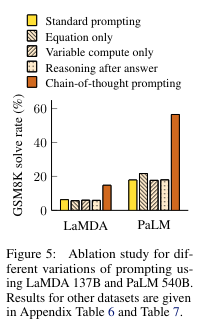
<p>To deduce the cause behind the success of the chain-of-thought method, the authors run several ablation studies:</p>

<ol>
  <li>There are no CoT steps in the exemplars (the experimental control);</li>
  <li>“The model is prompted to output only a mathematical equation before giving the answer”;</li>
  <li>“The model is prompted to output a sequence of dots (. . .) equal to the number of characters in the equation needed to solve the problem,” the equal-compute ablation; and when</li>
  <li>The few-shot exemplars contain the chain-of-thought after the answer, instead of before.</li>
</ol>

<p>These results are copied below.</p>

<p><img src="/images/posts/2025-03-chain-of-thought/fig5-ablation-study.png" alt="Figure 5 from Wei et al. (2022): GSM8K solve rates for LaMDA 137B and PaLM 540B under standard prompting, equation only, variable compute only, reasoning after answer, and chain-of-thought prompting." class="align-center" /></p>

<p>The authors implicitly hypothesise that CoT prompting improves reasoning performance because it induces the models to reason logically. That is, to somehow compute logical functions of concepts, and, “think through,” problems to solve them, much as humans do. Hence, they structure their ablation studies to identify the relationship between the models’ logical reasoning performance and the reasoning component of the CoT technique.</p>

<p>Their ablation studies are strong evidence that mathematical equations in CoT exemplars are not responsible for the CoT method’s benchmark improvements. Models prompted to merely include mathematical equations in their responses do not perform better than the control. Similarly, the authors show that prompting models to include the reasoning chains after providing the answer to the problem cannot be responsible for CoT’s improvements.</p>

<h3 id="methodological-flaw-in-the-ablation-studies"><strong>Methodological flaw in the ablation studies</strong></h3>

<p>The authors claim to successfully refute variable compute as a contributing factor (p. 6), but their ablation does not seem to directly address this variable. The authors claim that Ablation, listed above, causes the model to increase the token count it expends on the answer, thus, “isolat[ing] the effect of variable computation from chain-of-thought reasoning.”</p>

<p>However, for effective identification of the effect of variable compute, it would be necessary to increase compute to a level (approximately) equal to the compute used by the CoT-prompted model on the same task. Reviewing the quoted prompt for Ablation 2 above, it is unclear how the model will behave when conditioned on this prompt. On deeper analysis of this ablation, several flaws emerge.</p>

<p>First, it was known at the time of publication that LLMs could not accurately compute the length of prompted sequences (reference). Then, it seems unlikely that the model will respond to the prompt accurately, returning the number of characters required to solve the problem.</p>

<p>Second, even if models were able to track sequence length internally, it is not clear that the models in question have that capability. None of the foundation models tested were deliberately trained to anticipate the number of characters it will take to solve a problem, and there is no obvious reason to expect they should be able to.</p>

<p>Finally, the ablation seems to contain a logical contradiction. If the model knows how many characters its answer should take, does it not already know the answer? Perhaps the authors are assuming that the model will draw an approximate value of tokens based on similar problems. If such a convergence assumption is made, it should be stated, so that the paper’s conclusions can be interpreted.</p>

<p>Unfortunately, the authors did not report token count or other compute statistics for any of their methods. They also did not report any measure of whether the prompted ablation token lengths were convergent to the token lengths used in correct solutions.</p>

<p>Due to the flawed equal-compute ablation test, the cause of observed performance improvements is not identified as being related to the content of the few-shot exemplars. The results are still consistent with increased compute amount being responsible. Further work is needed to identify the effects of extra compute length and exemplar style on model performance, before deeper conclusions can be drawn about this prompting method.</p>

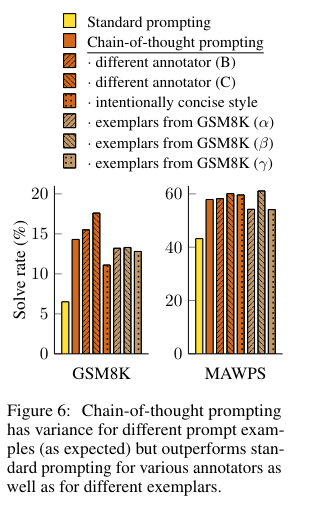
<p>Nonetheless, further ablation studies show that the technique is robust to different annotators, annotation style, and exemplar source material, which is impressive for practically applying CoT in LLM pipelines. These results are copied below.</p>

<p><img src="/images/posts/2025-03-chain-of-thought/fig6-annotator-robustness.png" alt="Figure 6 from Wei et al. (2022): GSM8K and MAWPS solve rates for standard prompting and chain-of-thought prompting with different annotators, an intentionally concise style, and exemplars drawn from GSM8K." class="align-center" /></p>

<h2 id="the-authors-interpretation">The Authors’ Interpretation</h2>

<p>The authors do not venture why the CoT strategy works, instead focusing on the emergent nature of CoT reasoning improvements. Observing that CoT only helps reasoning performance in models of greater than 100bn parameters, they note that:</p>

<ol>
  <li>“Small language models fail at even relatively easy symbol mapping tasks;”</li>
  <li>“Small language models seem to have inherently weaker arithmetic abilities;” and</li>
  <li>“Qualitatively… [in our experiments] small language models often did not generate a final answer that could be parsed;”</li>
</ol>

<p>concluding that, “the success of chain-of-thought reasoning as a result of model scale is a complicated phenomena that likely involves a variety of emergent abilities.” (p16) The authors thereby limit the scope of the paper to reporting their discovery and referencing some suggestive research for future investigation.</p>

<p>Perhaps this is good experimental practice in business: their experiments are limited to what is required to advance the state of the art, and they provide extensive code and suggestion for external researchers to continue investigating the causal mechanisms.</p>

<h2 id="our-interpretation">Our Interpretation</h2>

<p>Our reading group’s discussions concluded that the CoT method makes better use of the weights than standard prompting when applied to reasoning tasks, and we see a corresponding performance improvement. We believe this improvement comes from the sequential dependence in the token generation process.</p>

<p>Mimicking the CoT exemplars in its response, the model starts generating words resembling a thought pattern. Then, it, “feeds off itself,” providing finer and finer context for the next tokens, like a, “self-guided search process,” in high-dimensional activation space. With increased information density in the context, generation becomes ever more tightly conditioned, creating more targeted or coherent activations dynamics. As evidence, we refer to the CoT-after-answer ablation study. This study showed no performance gain, reinforcing the idea that reasoning must precede an answer to be useful, and lending credence to this autoregressive, or self-conditioning, interpretation.</p>

<p>This interpretation permits both a generalised reasoning and a stochastic parroting explanation for performance improvements, which we discuss in the next section.</p>

<h2 id="cot-and-generalised-reasoning">CoT And Generalised Reasoning</h2>

<p>The paper does not establish whether the models are reasoning in a generalisable way. An impressive contribution would be to distinguish whether CoT improves generalised reasoning ability, or is merely causing higher-resolution parroting of the training data.</p>

<p>This distinction matters: if CoT is just parroting, then its effectiveness depends entirely on the structured reasoning content of the training data. A parroting interpretation would have critical implications for fields including data quality, fine-tuning, distillation, AI safety, interpretability, and edge (small-model) deployments.</p>

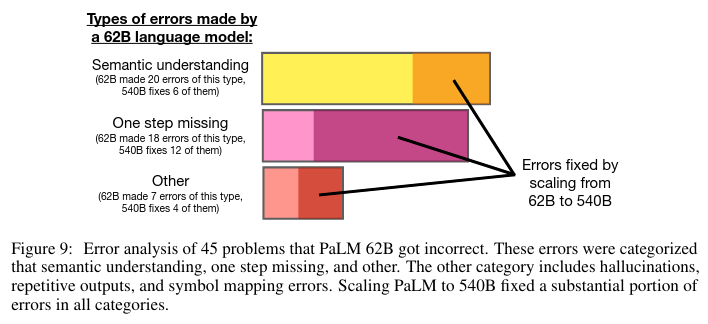
<p>The, “just-parroting,” theory is somewhat evidenced by the paper’s finding that CoT prompting is only effective in models of &gt;100B parameters. Smaller models may lack enough internal structure to reconstruct reasoning chains effectively, making them worse with CoT despite benefiting from traditional few-shot learning. This is reinforced by the results below, which show that scaling PaLM from the 63B to the 540B distilled model reduces both semantic (comprehension) and logical errors.</p>

<p><img src="/images/posts/2025-03-chain-of-thought/fig9-error-analysis.png" alt="Figure 9 from Wei et al. (2022): error analysis of 45 problems that PaLM 62B got wrong, split into semantic understanding, one step missing, and other errors, with the share fixed by scaling to 540B." /></p>

<h3 id="cot-does-not-imply-true-reasoning">CoT does not imply true reasoning</h3>

<p>The credibility of the parroting theory fits into a bigger picture: CoT prompting results are not hard evidence of LLMs performing logical reasoning. They merely show an association between reasoning-like inputs and improved model performance on benchmarks.</p>

<p>In the parroting interpretation, CoT introduces a prompt containing structured multi-step response exemplars, the model’s serial dependence causes it to remain in a reasoning-focused generation mode.</p>

<p>This does not require an underlying reasoning ability – only a bias toward generating structured outputs when prompted in a certain way. The associated improvements to reasoning benchmark performance could just be due to higher-resolution (better conditioned) parroting. Without clearer experimental evidence, the paper’s results are consistent with CoT being a well-calibrated retrieval strategy rather than a sign of emergent reasoning.</p>

<h3 id="reasoning-as-a-continuum"><strong>Reasoning as a continuum</strong></h3>

<p>However, if CoT can activate reasoning patterns which were seen in one part of the training data and apply it to different topics (“mixing” reasoning patterns across domains), this suggests that LLMs contain emergent computational properties beyond statistical pattern matching. This would be much closer to the sort of dynamic reasoning in human thought.</p>

<p>Then LLM reasoning may be a continuum: between parroting reasoning structures in-domain; and mixing reasoning patterns across domains. Mixing reasoning structures is an exciting concept, and perhaps heading in the direction of real machine creativity. Even if we limit our ambition to mere in-domain parroting, there is nonetheless great potential to improve LLM performance on explicitly trainable (supervised) tasks.</p>

<h3 id="small-models-arent-over"><strong>Small models aren’t over</strong></h3>

<p>Our third conclusion is that though improvements from CoT are emergent in large models, this does not mean small models are incapable of reasoning. Refined training procedures might efficiently train reasoning structures into their weights. Targeted optimisation could push small models with sparse or incoherent reasoning structures to behave more like ultra-large models, which memorise weaker reasoning signals simply by virtue of over-parameterisation.</p>

<h3 id="model-reasoning-chains-are-not-necessarily-interpretable"><strong>Model reasoning chains are not necessarily interpretable</strong></h3>

<p>Our final conclusion is that chains of thought generated by models are not necessarily human-interpretable. Though the model generates reasoning chains, and benchmark results improve, these tokens are a mechanical artefact of the model’s generation process.</p>

<p>It is unclear whether they should cohere with human reasoning structures or expectations. We are tempted to say that they should, as they have emerged from training on web and supervised data. Nonetheless, coherence is not guaranteed or obvious.</p>

<h2 id="challenges-and-open-questions">Challenges and Open Questions</h2>

<p>The group discussed many questions and challenges related to this paper. We leave these as open questions to spark the curiosity of the audience and members.</p>

<ul>
  <li>Do large models use their weights efficiently for reasoning, or is significant redundancy present?</li>
  <li>Why does shorter, more concise reasoning in exemplars weaken CoT’s effectiveness?</li>
  <li>Can we jointly train models to reason and produce interpretable reasoning chains?</li>
  <li>Where in the model’s weight space does reasoning emerge, and how can we measure or visualise it?</li>
  <li>How has model reasoning capability evolved from 2022 to now, and what architectural or training changes influenced this evolution?</li>
  <li>How can we quantify CoT’s computational efficiency across models?</li>
  <li>Are model reasoning errors interpretable in human epistemological terms, such as logical fallacies or cognitive biases?</li>
  <li>How can reasoning errors be mitigated or corrected during inference?</li>
</ul>

<h2 id="alternative-approaches-to-improving-reasoning">Alternative Approaches to Improving Reasoning</h2>

<p>While CoT is effective, participants noted several other ways to improve structured reasoning. Some have become popular and effective since 2022, when this paper was published.</p>

<ul>
  <li>Directly encoding domain knowledge: Training models directly on elementary algorithms, such as algorithms for multiplication or spelling that we teach to children.</li>
  <li>External solvers: Attach LLMs to tools, such as programmatic calculators, to handle structured problems. This may be a cheap and practical approach, but it is besides the point of building effective reasoning machines.</li>
  <li>Reinforcement learning: Instead of relying on emergent reasoning, reinforcement learning can be used to train thinking in formally verifiable subjects.</li>
  <li>Verifier-based approaches: Use secondary models to assess reasoning correctness. This introduces the problem of what to do when a verifier rejects a response, so it doesn’t address the reasoning problem. It is nonetheless a useful related tool.</li>
</ul>

<h2 id="conclusion">Conclusion</h2>

<p>Chain-of-thought prompting represents a significant advance in the performance of large language models on structured reasoning tasks. While impressive, the original paper’s methodology does not definitively establish that emergent reasoning is occurring in these models, leaving open alternative explanations such as enhanced parroting or self-conditioning during token generation. Our analysis highlighted important methodological weaknesses, particularly in the equal-compute ablation, which leaves room for further experimentation. Whether CoT prompting activates generalised reasoning or improves parroting remains an open question.</p>

<h2 id="bibliography">Bibliography</h2>

<p>Wei et al. (2023). <em>Chain-of-Thought Prompting Elicits Reasoning in Large Language Models</em>. arXiv:2201.11903. Retrieved from <a href="https://arxiv.org/abs/2201.11903">https://arxiv.org/abs/2201.11903</a></p>

<hr />

<p>This blog was originally posted at <a href="https://deep-network.org/2025/03/24/emergent-reasoning-or-enhanced-parroting-a-critical-analysis-of-chain-of-thought-prompting/">https://deep-network.org/2025/03/24/emergent-reasoning-or-enhanced-parroting-a-critical-analysis-of-chain-of-thought-prompting/</a></p>]]></content><author><name>Stephen Elliott</name></author><category term="Critical Analysis" /><category term="artificial intelligence" /><category term="chain of thought" /><category term="computer science" /><category term="LLM" /><category term="methodology" /><category term="reasoning" /><category term="research" /><category term="science" /><summary type="html"><![CDATA[A critical analysis of Google's 2022 paper on Chain of Thought Prompting, discussing interesting results, methodological questions, and implications.]]></summary></entry></feed>